Summary
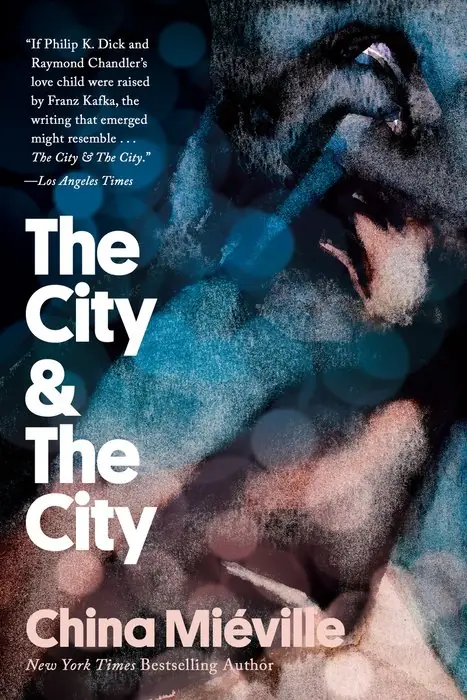
Beszel and Ul Qoma are two cities in eastern Europe. They occupy the same ground. Some streets belong entirely to one, some entirely to the other, and many are crosshatched, with buildings and pedestrians of both cities on the same pavement. Citizens are trained from childhood to unsee everything belonging to the other city: to look away from the traffic, to not hear the language, to walk around people they are not permitted to notice.
Deliberately seeing across the line is called breach, and Breach, the power that punishes it, is absolute and unaccountable and takes people away.
Inspector Tyador Borlu of the Beszel Extreme Crime Squad has the body of a young woman who was killed in one city and dumped in the other, which makes this either an ordinary murder or the worst thing that can happen. The investigation moves through nationalists, unificationists, archaeologists and a foreign university, and Borlu's problem is procedural rather than metaphysical: he has to look at evidence he is legally forbidden to see.
Miéville plays the whole thing as a straight police procedural, in flat unshowy prose, and never once explains the arrangement in fantastical terms. Every explanation the book offers is political and historical.
The pleasure is watching the rules operate. Two drivers in different cities avoid a collision without acknowledging each other. Before Borlu may cross, he has to sit an orientation course on being in Ul Qoma while unseeing the Beszel all around him. Crossing legally through Copula Hall, he finds that one stretch of grass is Majdlyna Green in Beszel and Kwaidso Park in Ul Qoma.
The murder plot is competent rather than dazzling, and readers who come for the mystery alone sometimes find it thin. The reason to read it is the idea, executed with total discipline.
Around three hundred and twenty pages, plainly written, and it works completely for readers who never touch fantasy.
Best for readers who want crime fiction that quietly rearranges how they walk down a street afterward, and it does exactly that for about a week.
Historical Context & Significance
The City & the City shared the 2010 Hugo Award for Best Novel with Paolo Bacigalupi's The Windup Girl, only the third tie in the category's history. It also won the World Fantasy Award, over James Enge's Blood of Ambrose, Jeff VanderMeer's Finch, Kit Whitfield's In Great Waters and Caitlín R. Kiernan's The Red Tree, as well as the Arthur C. Clarke Award, the BSFA Award and the Locus Award for Best Fantasy Novel, and it took the Hugo despite containing nothing that is unambiguously fantastical.
China Miéville came out of the New Weird alongside writers reacting against traditional fantasy, and holds a doctorate in international law, which shows in the novel's fascination with jurisdiction as a thing people enforce on themselves.
He wrote it as a gift for his terminally ill mother, a keen reader of crime fiction who used to hand him detective novels to try. The BBC adapted it in 2018 as a four part series with David Morrissey.
Where to get it
We may earn a commission if you buy through these links, at no extra cost to you.
Opens WorldCat, a catalog of library holdings run by the nonprofit OCLC. We do not ask for or receive your location.