Summary
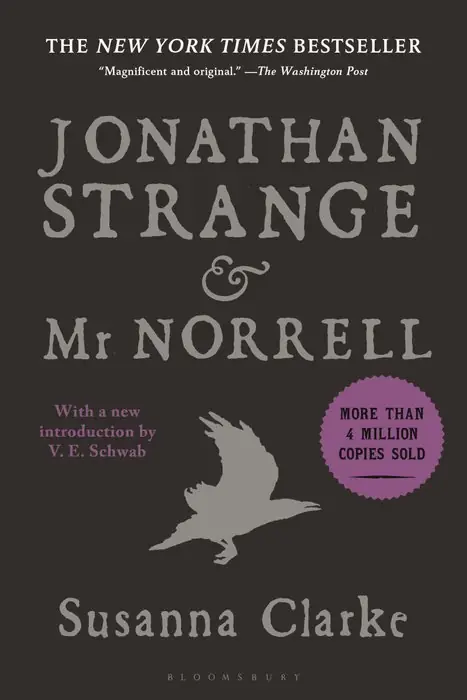
English magic died centuries ago and is now a subject for gentlemen scholars who study it and do not practice it. Then Mr Norrell, a small, pedantic, jealous recluse in Yorkshire with a library nobody else may enter, proves he can perform it by making the statues of York Cathedral speak.
He moves to London to make magic respectable, to help the government against Napoleon, and to make sure no other magician ever works again. To establish himself he raises a young woman from the dead, and the bargain he makes with the gentleman with the thistledown hair to do it is the wound that runs through the entire novel.
Jonathan Strange becomes his pupil: younger, careless, brave, and a natural, who goes to the Peninsula to move roads and rivers for Wellington. Their falling out is over the Raven King, the medieval magician who ruled northern England for three centuries and whom Norrell insists England should forget.
Clarke tells it in the voice of a nineteenth century novel, with 185 footnotes recounting the history and folklore of English magic, several of which are better than most short stories.
The fairy is the terror of it. The gentleman with the thistledown hair is charming, entirely amoral, convinced of his own generosity, and steals Lady Pole and Stephen Black away every night to dance in a decaying hall, leaving them unable to say a word about it because he has enchanted their speech into nonsense. Nobody believes either of them for six hundred pages.
Stephen, a Black butler in a London house, is the moral center, and the novel knows exactly what it is doing by making the man promised a kingdom the one person nobody in England will listen to.
It is around eight hundred pages, slow, dry and extremely funny, with a comic register borrowed straight from Austen, and the last two hundred pages are frightening.
Best for readers who love Austen and Dickens and want them haunted, and who will happily read footnotes.
Historical Context & Significance
Jonathan Strange & Mr Norrell won the 2005 Hugo Award for Best Novel, the World Fantasy Award, the Locus Award for Best First Novel and the Mythopoeic Award, and it reached the Whitbread and Guardian first book shortlists, an unusually wide reception for a fantasy debut.
Susanna Clarke wrote it over roughly ten years, in her spare time while working as a cookery book editor in Cambridge, and it was her first novel, published when she was forty four.
Illness kept her from publishing another novel for sixteen years, until Piranesi in 2020, which won the Women's Prize for Fiction.
The BBC adapted this book as a seven part series in 2015. Neil Gaiman, who had been sent one of her first stories by her partner, Colin Greenland, called it "unquestionably the finest English novel of the fantastic written in the last seventy years."
Where to get it
We may earn a commission if you buy through these links, at no extra cost to you.
Opens WorldCat, a catalog of library holdings run by the nonprofit OCLC. We do not ask for or receive your location.