Summary
Three women, three cities, one day each, cut together.
In Richmond in 1923 Virginia Woolf wakes with the first sentence of Mrs Dalloway, endures a visit from her sister, escapes toward the station, and is retrieved by a husband who moved them out of London for her health and will not move them back.
In Los Angeles in 1949 Laura Brown is pregnant, reading Mrs Dalloway in bed, and trying to bake a birthday cake for a decent husband and a watchful small son. The cake fails. She makes another. Then she books a hotel room for the afternoon and the reader spends several pages genuinely unsure what she intends to do in it.
In Greenwich Village in the 1990s Clarissa Vaughan goes out for flowers for a party she is throwing for Richard, a poet dying of AIDS who has called her Mrs Dalloway since they were young and who does not want the party.
Cunningham matches Woolf's method rather than borrowing her plot: one ordinary day, minute by minute, with a whole life pressing on it. Each woman also gets a visitor she cannot manage, a sister, a neighbor, an old lover, so the three days rhyme without ever being forced into parallel.
At roughly two hundred and thirty pages it is short and the chapters are shorter, most of them six or eight pages, which makes it far easier to read than its reputation suggests. You do not need to have read Mrs Dalloway, though the last twenty pages hit harder if you have, and the connection between the three strands is held back until then. Expect suicide, illness and a great deal of thinking about whether an ordinary hour is enough. Best for readers who want intensity over incident.
Historical Context & Significance
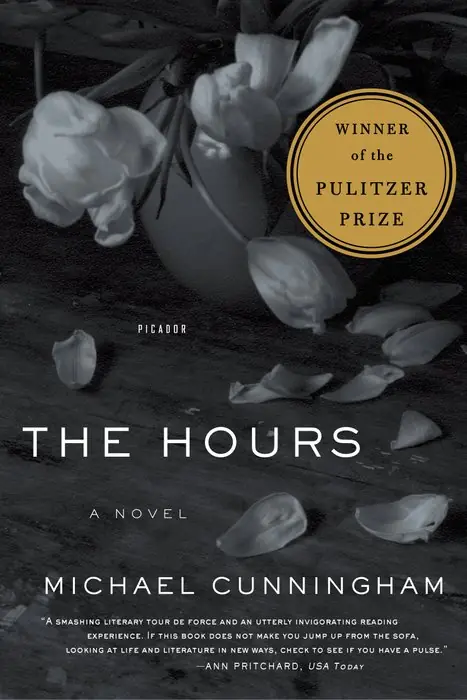
The Hours won the 1999 Pulitzer Prize for Fiction and the PEN/Faulkner Award. The novel pays tribute to Woolf's Mrs Dalloway across three settings: Woolf writing it in Richmond in 1923, Laura Brown reading it in Los Angeles in 1949, and Clarissa Vaughan planning a party in New York in 1999.
Michael Cunningham has said Mrs Dalloway, which he read in high school, was the first great novel he ever read and went right through him, and his 2008 essay Company is expressly about her influence on him.
Stephen Daldry filmed it in 2002 from a screenplay by David Hare, with Meryl Streep as Clarissa, Julianne Moore as Laura and Nicole Kidman as Woolf. Kidman won the Academy Award for Best Actress, though Richard Schickel, in Time, found himself focusing on "the unfortunate prosthetic nose Kidman affects in order to look more like the novelist.".
Where to get it
We may earn a commission if you buy through these links, at no extra cost to you.
Opens WorldCat, a catalog of library holdings run by the nonprofit OCLC. We do not ask for or receive your location.